Merrimack’s Miller ready for return to boys lacrosse team after battle with cancer
Matt Brewster is in his fourth season as the coach of the Exeter High School boys lacrosse team and he’s led the Blue Hawks into some big games.
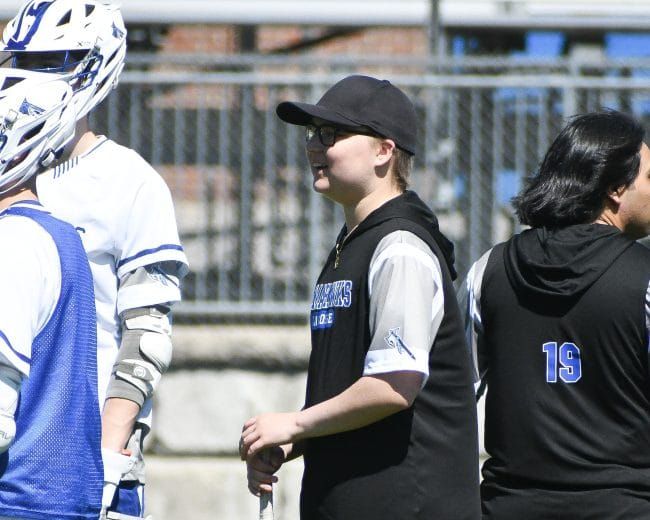
Matt Brewster is in his fourth season as the coach of the Exeter High School boys lacrosse team and he’s led the Blue Hawks into some big games.
They played for a Division I championship in his first year in 2022, and in the final four each of the last two seasons, but those moments don’t compare to the anticipation he’s felt for Wednesday’s game against Merrimack.
It’s another opportunity for Brewster, who graduated from Merrimack in 2015, to matchup against the program he played for and the coach, Brian Miller, he considers a mentor.
But this time, this game will have much more meaning to it.
For the last couple of seasons, Exeter has championed a number of fundraisers at various home games, and for this game against Merrimack, the Blue Hawks will be recognizing Stick It To Cancer, to raise funds for the American Cancer Society.
“We’ve done the Stick It To Stigma games, I thought let’s do a Stick It to Cancer game,” Brewster said. “Let’s do donations. We got stickers for both varsity and JV teams (for the players’) helmets. Every kid is going to have it before the game. It’s something that is recognized and it’s going to mean a lot to them, and it’s going to mean a lot to me.”
And it’s going to mean a lot to Miller, and his son, Jake, a senior at Merrimack.
It’s going to mean even more to all three of them when Jake takes the field at Bill Ball Stadium. A year ago, no one knew if that would happen again.
‘Worst day of your life’
Brian Miller was excited for the start of the 2024 season, not just because he’s the Merrimack head coach, but it was a bit of a milestone for him. That year’s junior class, which included Jake, would see a more prominent role on the field, and many of the players in it, he’d been coaching for a long time.
But throughout the year, Jake, who has also played soccer and basketball at Merrimack, had felt exhausted after most of his games. When the spring season started, that feeling was getting worse.
“Last preseason, he was battling something but we didn’t know what,” Brian said. “He had trouble breathing, he’d get short of breath in practice really fast. Coming out of winter, we thought he was sick.”
Jake, who has had asthma for as long as he can remember, thought it just had something to do with that and tried to push past it.
“I felt more out of breath than usual,” he said. “I’m pretty athletic, but it didn’t feel right. I was tired after sprints and I had to sit out more than usual. That was a whole preseason thing. First game happened, I went in for one shift and had an asthma attack.”
The attack was bad enough that, after the game, the Millers went to the emergency room at Elliot Hospital in Manchester. A couple of days later, they received the worst possible news.
“An X-ray revealed a huge mass that covered his entire chest cavity,” Brian said. “It was a giant cloud. Officially, April 10, 2024, he was diagnosed with acute lymphoblastic lymphoma.
“It’s the worst day of your life when it’s your kid. To have to face a serious illness, with your family, it’s one of the hardest things in your life, I think.”
There were a lot of things rushing through Jake’s head after the diagnosis, the biggest being fear.
“At first, I was pretty scared, like what is going on?” Jake said. “What’s wrong with me? My mom and dad were crying, I did, too.”
Silver linings
After the diagnosis, Jake was transferred to Boston Children’s Hospital, where he spent more than three weeks undergoing treatment.
“His first two weeks, he was actually in the ICU because of his breathing,” Brian said. “He wasn’t in any trouble, but because of the monitoring he needed, because of his situation, he had to be in the ICU.”
Acute lymphoblastic lymphoma is a form of non-Hodgkin lymphoma that develops from immature lymphocytes in the bone marrow or blood. While survival rates in adults is under 50 percent, there’s up to an 80 percent survival rate in children.
“The treatment for ALL is pretty standard in general,” Brian said. “There are bumps along the way, but that’s all a result of reactions to medications. The protocol is pretty standard. We’re going to do ABC and that’s what you do for the most part, maybe a couple of changes here and there. Like everybody else, we’re fortunate to have some of the best doctors in the world less than an hour away.”
The mass was gone in about a week, although the treatment Jake is on takes two full years to complete.
“It was a hard time at first, but I’ve learned to live with it and not let it run my life,” Jake said. “Now I just don’t think too much about it because it’s a regular thing now.”
It also helped in a way that this wasn’t the first time Brian and his wife, Caryn, had dealt with cancer.
When both of their children were young – the Millers also have a daughter, Sydney, who is a sophomore at Merrimack – Brian was diagnosed with Ewing Sarcoma, a malignant bone tumor, in his right leg. Unlike Jake, part of Brian’s treatment involved surgery, which left a large scar down the outside of his leg.
“I had accepted coming on as an assistant (at Merrimack) and after that I was diagnosed,” he said. “One of my first practices, I’m yelling and screaming at the kids and I’ve got blood dripping down my leg because I’d just had surgery. They’re like who is this guy, this guy’s a lunatic. When I was in treatment, I dealt with it through humor.”
Like father, like son, in that regard. The Millers became known as the “easy” family when Jake has gone in for treatment, with Brian recalling one nurse thanking them for bringing some sarcasm to her day.
But while their sense of humor brought moments of relief, Brian’s experiences also brought moments of calm for Jake.
“Since he had it, he’s probably been the most helpful,” Jake said. “He knows what it’s like to be poked and tested, have days where you feel crappy. He just knows what it’s like, so that’s been really helpful.”
It also helped when trying to understand some of the things the doctors were telling them.
“For me, being able to interpret language from doctors and read between the lines, it was easier for me,” Brian said. “I could hear what they’re saying. When they use certain words and say certain things, part of it is scary, because now your kid has to deal with it. But then part of it is reassuring because you’re like ‘oh that’s only going to last a week.’”
Back in Merrimack
Max Giles and Henry Tobin had played sports with Jake, and been coached by Brian, almost from the time all of them started being active.
At first, they and their teammates thought Jake was just having a problem related to asthma.
“What I remember hearing was that it was a problem with his inhaler, because he has asthma,” Tobin said. “I thought it wasn’t working well enough, he needed a new one, so I thought it wasn’t anything too serious and he was going to be fine for the season. Then as the news hit and we heard about it, I was completely blindsided. I had no idea. It was a complete shock.”
For Giles, it was unfortunate news he’d heard before, having had a teammate on the Merrimack ice hockey team previously diagnosed with cancer.
“It was a shock to know that one of our best friends who we’ve been playing lacrosse with our whole lives got diagnosed with cancer and it was sad to see,” he said. “You don’t really cherish something like playing lacrosse with all your friends until one of the guys can’t be there every day with you.”
Instead of having Jake there with them, they decided to go to Boston to be with him.
“Third day, Henry Tobin texted me, and it wasn’t can I come down, it was when can we come down,” Brian said, adding what it was like having Jake’s classmates visit him in the ICU. “You’ve got five (high school kids) coming in to visit, playing video games with him, joking and laughing while other people are in dire straits.”
Although he wanted badly to be on the field, Jack didn’t bring up how the team was doing or anything about lacrosse much when his friends were there.
“I didn’t think too much about lacrosse,” he said. “We watched the games when we could. I just did Legos most of the time. It got my mind off it. I had my friends visit. A lot of them came. It was pretty nice, knowing that they cared and they were worried about me.”
Being there was never a question for Giles or Tobin. They visited with other players and their parents. They got permission from athletic director Adam French to have the team sign a lacrosse helmet to give to Jake.
But not only did they have to adjust to their friend and teammate not being there, they were playing some games without their coach. With Brian spending more time away with Jake, assistant coach James Costa stepped in to lead the team at times.
“With coach being gone, we had to be a lot more focused in practice, go with the flow a little bit more because things were a little bit different,” Tobin said. “It also fueled the fire for games, playing for Jake and playing for coach.”
The Millers had more than just the boys lacrosse team in their corner.
“Parents of seniors came without their kids,” Brian said. “People visiting colleges in Boston, came to visit. The support from the Merrimack community and beyond was … we’ve kept a list, and it’s a big one.”
Hearing that was no surprise to Brewster, who saw firsthand how Brian was able to change things within the lacrosse community in Merrimack.
“Merrimack lacrosse has come a really long way and that’s because of him,” Brewster said. It starts down in the youth program, and it’s good to see lacrosse growing. He’s had a big hand in doing that.”
One more hurdle
After being unable to play during the soccer season, Jake was hopeful that he might get back for some of the basketball season before it was time for lacrosse.
Those plans fell apart not long after the holidays.
“The wildest part of this whole story, as terrifying as that first month was, Jake had a stroke in January,” Brian said. “One of the medications he was one, it’s rare, but one of the side effects are blood clots. The odds of getting blood clots are very low and he was the lucky one who got two.”
The clots cut off blood flow to Jake’s brain, and while he didn’t have the typical symptoms of a stroke, he lost feeling in his leg to the point he fell over at the house a few times. With Brian carrying him to the car and into the emergency room, Jake went back in wondering what else was wrong.
“At first, I thought it was just a headache,” he said. “I had a headache for a few days straight. I lost feeling in my leg. What else could happen.”
As a result, his doctors put Jake on blood thinners, and because of that he wouldn’t be cleared to return for basketball, and the start of the lacrosse season.
But in the last two weeks, he’s finished with the medication that caused the clots, and in turn, he’s done with the blood thinners.
“He couldn’t sustain any contact,” Brian said. “He just got off that drug and blood thinners. Now he’s good to go. He still has to deal with the rigors of being a lacrosse player.
“The greatest part of the story is, my son is cleared to put a lacrosse helmet on and get slashed by somebody in practice. He’s fair game now, so if he talks crap, you can check him.”
Return to the field
Neither Brian nor Jake were sure when exactly he’d be back on the field, but thought that the Tomahawks’ game at Exeter was a good target. It turned out, Merrimack needed Jake to fill in for an injured player during last Friday’s game against Nashua South, but as the season moves on, he’ll see more action.
“It’s nice to get the pads back on,” Jake said. “Feels like I’m back to normal a little bit. I don’t know how much I’ll play. It’s probably not a lot, I’d assume, but that’s the plan. It’s going to be pretty special getting back on the field for the first time in almost two years.”
Brewster has had a big hand in helping Jake be prepared for whenever he returns. As the owner of Perfect Ten Training in Bedford, he’s had the chance to work with Jake as part of a private strength and conditioning program he runs.
“He’s been coming to me for a little bit now,” Brewster said. “It’s been great. It’s a private facility, so it’s just me and him in there. We’re able to work on his strength and flexibility. Help him be an athlete. That’s the normal thing. He can come in there and shoot hoops and do his lifting, listen to some music. It’s a good relationship that I’ve gained with him.”
Growing up, Brian recalls Jake being one of the top offensive players on both his youth teams and Merrimack’s junior varsity. But now, whatever he’s capable of doing on the field, is more than enough for the coach.
“It’s going to feel great, but it feels great every day having him here,” Brian said. “It doesn’t matter what happens. Jake was always one of the leading scorers for the youth team and he was the leading scorer for the JV team. He was always around the ball. He gets the game, he gets how to do it. The fact that he’s doing his thing is all that matters.”
Brewster echoed those sentiments, adding that it wouldn’t just be Brian having those feelings for Jake.
“I think it goes bigger than just Jake,” he said. “It’s the community and the understanding that we’re all in it together. It could be anybody. He’s an absolute warrior. I can’t wait to watch him continue to play. My heart is full for him.”